
Modern education emphasises approaches that identify individual differences and help students realise their potential, with the aim of nurturing happy, healthy, productive and adaptable individuals who contribute to society. The Temperament-Based Education and Guidance approach, developed from the Nine Types Temperament Model (DTMM), is based on the concept of temperament, described within the model as an innate, lifelong structure influencing perception, motivation and outlook. It aims to identify individual differences and establish educational and guidance approaches suited to them.
The Temperament-Based Education and Guidance approach proposes that temperament type is a fundamental factor underlying individual differences. In this model, temperament represents the main motivations behind a person’s pursuits and behaviour and organises behavioural, emotional and cognitive patterns. Focusing on temperament types is intended to help identify each student’s priorities in perception, psychological needs, motivations, abilities, interests and tendencies, alongside characteristics that may present difficulties.
All parents want to understand their children better. We may wonder how our messages are understood, or whether they are understood as intended. During stressful situations or communication difficulties, we may be unsure how to respond and feel that nothing works. This approach begins by recognising and accepting that children, like adults, have their own temperaments. We all have differences and may respond very differently to the same situation.
What Is the Nine Types Temperament (Enneagram) Model?
According to the Nine Types Temperament Model, each person is born with one of nine temperament types. Each type has its own core pursuits, tendencies and needs. The types are named after the most fundamental needs and pursuits attributed to people within them.
Are Temperament, Character and Personality the Same?
Temperament is described in this model as an innate and enduring structural core with distinctive perceptions, pursuits, motivations and potential. It influences fundamental needs, expectations and outlook. The model compares temperament to DNA: just as DNA carries information about physical characteristics, temperament is presented as a kind of psychological blueprint for behavioural, emotional and cognitive tendencies.
Character develops when temperament characteristics become stable, clear and consistent. If temperament is a seed, character can be compared to the thick branches of a tree. For example, when someone with a tendency towards anger repeatedly displays angry behaviour and is described by others as an angry person, this is considered a characteristic of their character.
Personality emerges through the interaction of temperament with relatively stable factors, such as intelligence and biological characteristics, and more changeable influences, including environment, culture, family, education and life events. Temperament is regarded within the model as the structural foundation of personality. If temperament is a seed and character the tree’s thick branches, personality can be understood as the whole tree.
Before identifying a temperament type, it is useful to understand two concepts. Understanding them makes it easier to identify a type and consider how to respond to its characteristics.
Core Temperament and Wing Temperament
Core temperament: is the temperament type a person uses most strongly and frequently. It also points to the centre and subdivision considered dominant in the model. For example, having a core temperament of 1 is described as making greater use of the thinking subdivision of the action or physical centre.
Wing temperament: In addition to a core temperament, each person is influenced to some degree by another type, called a wing. This influence may be stronger or weaker and adds variety to the core type. Within the model, each individual is understood as a distinctive combination of a dominant core temperament and a less influential wing temperament.
Each temperament is represented by a number. When the types are arranged in a circle, the types immediately to the right and left of a number are its possible wings.
ATTITUDES UNDER STRESS AND IN RELAXED STATES
Under pressure or prolonged negative influences, people may behave differently from their usual patterns. These responses are understood in the model as ways of coping with stress.
Likewise, when people experience positive and reassuring circumstances, they may show more positive attitudes than usual.
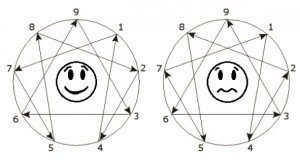
Stress line:
When someone faces stress they cannot manage, the model describes them as showing an unhealthy expression of a temperament other than their core type. This is called their “stress line”. The person is described as displaying unhealthy characteristics of the type towards which they move under stress.
Here, stress and the stress line refer to situations in which a person cannot cope with or change the causes of stress using their usual resources. The model proposes that when the core temperament’s characteristics are insufficient, the person responds through another mechanism.
The attitudes displayed under stress may be the ones a person usually dislikes most. For example, the model describes a Type 9 individual as seeking harmony, calm and peace and avoiding disagreement, conflict and tension. Under sustained pressure, that person may instead show disharmony, stubbornness, opposition and conflict, described here as unhealthy characteristics of Type 6.
Relaxation line:
When a person feels relaxed and calm, the model describes them as displaying a healthy expression of a temperament other than their core type. This is called the relaxation line.
Relaxation here means feeling at least partly satisfied in one’s central pursuits and safe in relation to core fears and things one tends to avoid. In this state, the person can step back from habitual protective mechanisms and show positive attitudes not usually associated with their core type.
Within the model, a relaxed state is described as bringing out qualities that a person needs and that support development. For example, a Type 9 individual in a relaxed and calm state may display complementary qualities such as focus on a goal, determination, enthusiasm and sustained effort until the goal is achieved, described as healthy characteristics of Type 3.
In this model, feelings of insecurity, unease and anxiety are associated with unhealthy Type 3 characteristics, including dishonesty, manipulation, selfishness, aggression and irritability.
The unhealthy patterns described under stress and healthy patterns described in relaxed states are generally temporary. However, the model suggests that prolonged stress or sustained calm may make some of these patterns more persistent.
What Are the Nine Temperament Types?
Type 1: Seeks perfection / The Perfectionist
Type 2: Seeks emotional connection / The Helper
Type 3: Seeks an admired self-image / The Achiever
Type 4: Seeks meaning in emotions / The Romantic
Type 5: Seeks understanding through knowledge / The Investigator
Type 6: Seeks intellectual reassurance / The Questioner
Type 7: Seeks the pleasure of discovery / The Adventurer
Type 8: Seeks absolute strength / The Strong Leader
Type 9: Seeks physical and sensory comfort / The Peaceful, Harmonious Type
These are the main characteristics and behaviour patterns used to introduce the temperament types.